You don’t learn this once
As I go through my indie dev journey, I realize how easy it is to make the same mistake…
Over and over again.
It’s tough to learn.
I used to think writing things down was the answer.
But writing things down is easy.
Actually making the same mistake, realizing and owning up to it is a lot harder.
Your brain can find more comfort in irational reasoning, rather than admitting you fell into the same trap again.
But owning up to it gives you power.
The power you need to learn that lesson for good.
But that’s not enough.
My own example in this post – Stop trying to be original will show you…
This is like exercising a muscle at the gym.
You need to keep working it.
Reminding it of the work.
Cos if you forget to or neglect it…
It falls back to it’s original state.
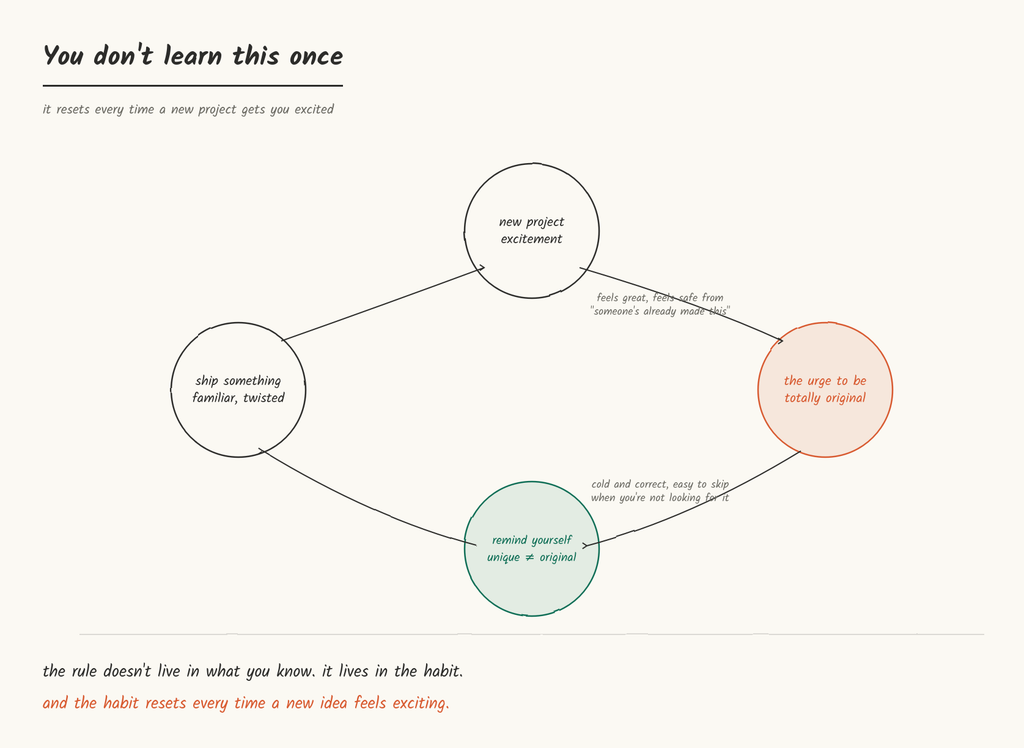
I can’t tell you how many times I’ve fallen back into the ‘make something original‘ way of thinking.
Despite reading dozens of self help & creative books that remind me nothing is original.
I’m starting to disagree.
You can definitely be original.
The bigger question is…
Do you want to be?
There’s some sort of artistic romanticism surrounding being original…
But in our space – game development – it will often hurt you a lot more, than if you just take what works…
And add your own unique twist.
Unique ≠ original.
The shrimp dessert
Follow me on this glorious example & imagine:
You love ice cream.
So much so, that you each chocolate ice cream every day.
But one day, it just doesn’t hit the same way.
Have you finally made yourself sick of it?
Chasing that dragon – You want something new.
You want to experience chocolate ice cream for the first time again.
You want that feeling again, but more of it.
What would make sense, is a brownie ice cream.
One day you’re at the supermarket.
You see the brownie ice cream tub, it looks almost identical to your beloved chocolate flavour.
But the bonus is the small brownie chunks on it!
It reminds you of your favourite flavour.
You’re excited to take it home and grab a spoon.
Now rather than brownie ice cream…
Imagine you find a weird, but new (and original!) Shrimp flavoured sweet dessert.
It’s Shrimp, mixed with sugar and syrup.
It’s brand new at the supermarket, made by a new local company.
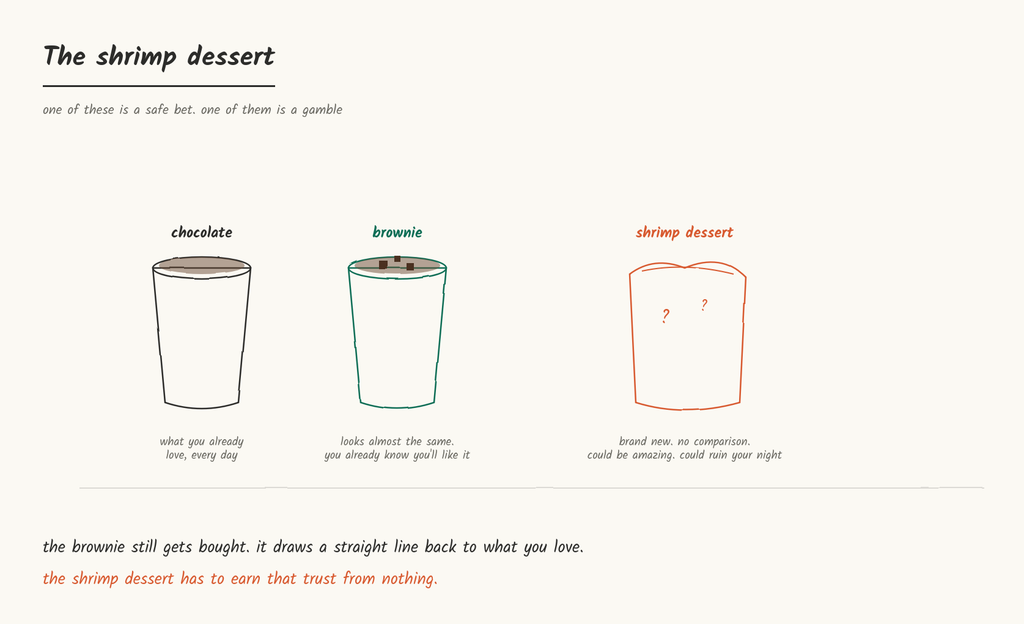
Now, it could be absolutely delicious.
But you’ll never get to figure out (unless you felt freaky that day).
The brownie tub reminds you of you chocolate, it draws parallels.
The Shrimp dessert really has no comparibles, so if you decide to opt for it, you’re taking a risk.
Let’s say you’re cutting back to 1 or 2 desserts per week.
Are you really gonna run the risk of getting something you don’t enjoy?
When you know there’s an option you’re guaranteed to like.
How this works in games
You can use that analogy in any other purchasing decision.
We’re risk averse when we are making investments, whether that’s our time, money or energy.
When we play games, we’re expending all 3.
Sometimes we play a game so much that we just crave more of it.
Beat the game, explored all content, but we crave more.
Either a DLC or a new game that satisfies the same need.
Most of us have went through it.
And when we do, we’re not then looking for a game that’s “sorta like it, but original and actually totally different”.
A real example I went through was with Dungeon Keeper.
As a kid, I loved both DK 1 and 2.
So I was gutted when Bullfrog cancelled DK3.
That was all the way back in 2000, but I probably found it out in 2004.
I had to wait until 2015 until I could get my hands on War for the Overworld.
In between then, a bunch of games that looked inspired by DK and wanted to appeal to it’s fans appeared.
One of those was Impire.
The problem was, they offered none of the defining features that the originals provided.
Full flexibility to design the dungeon of your dreams…
Was reduced to placing static prefab style rooms.
Traps became largely useless, since heroes would use ladders to jump down to random spots in your dungeon.
Impire looked like DK.
The marketing begged us fans to take notice.
But “Reminds you of” only pays off if the game delivers.
It gets you to take notice.
It doesn’t stop you from refunding.
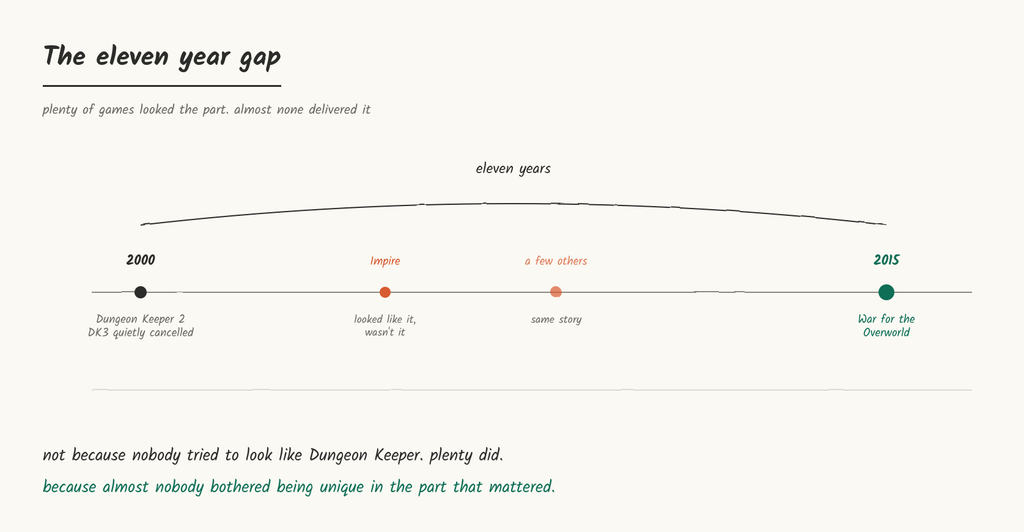
It wasn’t original.
If it was, I wouldn’t have even noticed anyway.
What the shrimp dessert version actually looks like
Imagine a dev in 2005 looked at the gap in the DK market and decided another dungeon builder was too obvious.
Many of us make this mistake.
So instead, they went on teh quest to make something “totally original”.
You play as a sentient cave system.
No dungeon.
No minions.
You grow rooms by consuming light.
Combat is solved through a rhythm mini game.
Never been been done, but not impossible to build.
But it flops, quietly, because nobody hunting for their DK fix could tell this game had anything to do with their craving.
It’s not on the shelf they’re browsing.
It doesn’t even look like food.
What did win
Meanwhile, War for the Overworld just said “it’s dungeon keeper” and put minions and traps back in your hands.
Everyone starving for that flavour found it immediatly.
It wasn’t safe because it was unoriginal.
It was safe because it was legible next to the exact hunger it was trying to feed.
What made it good wasn’t the concept…
It was that it promised something we were all missing dearly.
Unique in the part that mattered, recognisable everywhere else.
The email problem
I bet War for the Overworld had the simplest email promotion campaign in game history.
“Remember your 15 year wait for Dk3? Yeah, we’re ending that. Here you go!”.
Versus our organic cave growing, no minions, rhythm based combat game…
How do you even market that?
What’s the Steam description going to look like?
The subject line for your email campaign?
The Youtuber video titles?
All of those become so much easier when you can say:
- Like {game X} but with {Y}
- Remember {game X}? Now it has {Y}
- What if {game X} had {Y} in it?
Take a scroll down Let’s play channels, especially indie game focussed ones like: Nookrium, Splattercat or Wanderbots.
They do this all the time.
After all – they’ve got the same job as us.
Selling game concepts to players.
We design the game & it’s appear, then develop it.
They discover games they think have potential.
Both of us need to sell it to an audience.
We benefit from game sales, they benefit from views.
It all comes from people finding the game appealing.
If I’d just made Islanders
In my case with Working Class Monsters – it was my latest fall into the originality trap.
I remember from the early days of planning and (extremely loosely) prototyping the game – I wanted to make something different.
Something that the incremental market hadn’t seen.
That was my problem.
Because only 5 months later, when I was setting up my email promotion campaign, I hit a problem:
How the fuck do I describe this game?
It never quite healed.
And I was in too deep.
I realized, it took a lot of energy for me to describe this game in my email pitches.
So surely it took a lot of my potential customers’ energy too.
When it’s not relatable or easy to grasp, the easy decision as a shopper is to move on.
Skipping to the next game costs nothing.
So it wasn’t until post-launch, during my post-mortum sessions, it dawned on me:
I should’ve made Islanders.
Not to a tea, not plagiarism.
But it’s a game I love. It’s a game that works.
My game is essentially the same economy.
Just with 4 or 5 extra steps that makes it more complicated and less fun.
This was the reward from my quest to be original.
So, even though they’re mechanically similar, do people look at Working Class Monsters and remember Islanders?
Nope.
Players aren’t done with the old flavour
For years my mistake was thinking:
“If a game exists, they’ll just play that”.
Forgetting, that flavours get old and stale after a while.
The feeling of wonder fades.
But the players still crave more.
We need to just give them it.
Don’t try and force something original on a player because you think they’ll like it.
Just give them what they already want.
You’ll thank yourself later.
Especially when you’re starting your promotion.
And especially if you want to make a successful business out of this.
Activity time
Take a think – what games have you personally finished and immediately gone looking for “more of this”?
Would you have been open to something completely original and unrelated to that craving?
Brownie is still ice cream
Let’s end this mad ramble with some quick points that I think will help:
- Don’t just clone: Take something, add a spin or twist that fits the game/genre. Check the hundreds of Vampire Survivor clones that sit with <10 reviews. People already had Vampire Survivors. What they didn’t have, was Megabonk.
- Know your comparison before you build: If you can’t finish “It’s like X” in a sentence during pre-production, that’s a design flag, not a marketing problem to solve later. You’ll make a worse game by forcefully warping it into a different game later down the line. Do it upfront.
- Make the twist sensible: It’s common to hear “make X with a twist” – it’s good advice, when you know what it means. My Impire example had the looks and vibe, but failed because it binned the fundamentals that made DK what it was. Your twist/spin should add to the game, not just make it different.
- You don’t learn this once: You need to keep reminding yourself not to be original. If you’ve done it before, the craving to make an original game will slip back in. Hell, I started doing it yesterday. When I’ve already learned this lesson 3 times now. Make it a practice when you’re designing or thinking about game ideas. Ask yourself – What game is this gonna be like? Can’t answer? DANGER!