Short Definition
Definition
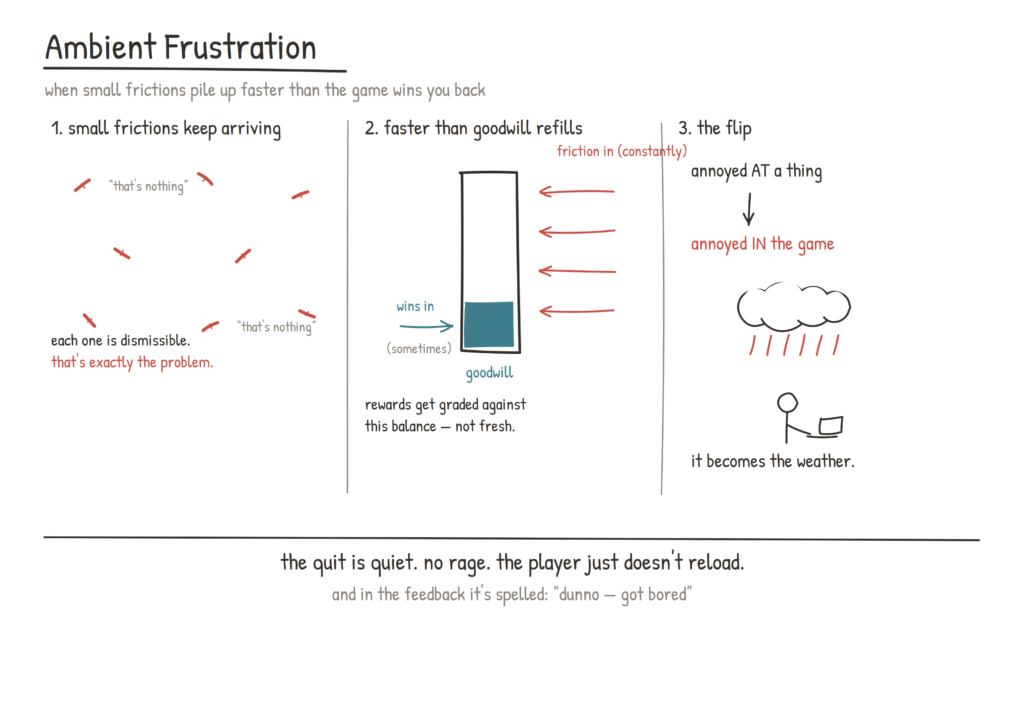
Ambient Frustration: is a term I came up with while playing Dome Keeper. It’s what happens when lots of small frictions – none big enough to complain about on their own, start piling up faster than the game can win you back. You stop being annoyed at any one thing and start being annoyed in the game.
What is Ambient Frustration?
The "meh" restaurant analogy
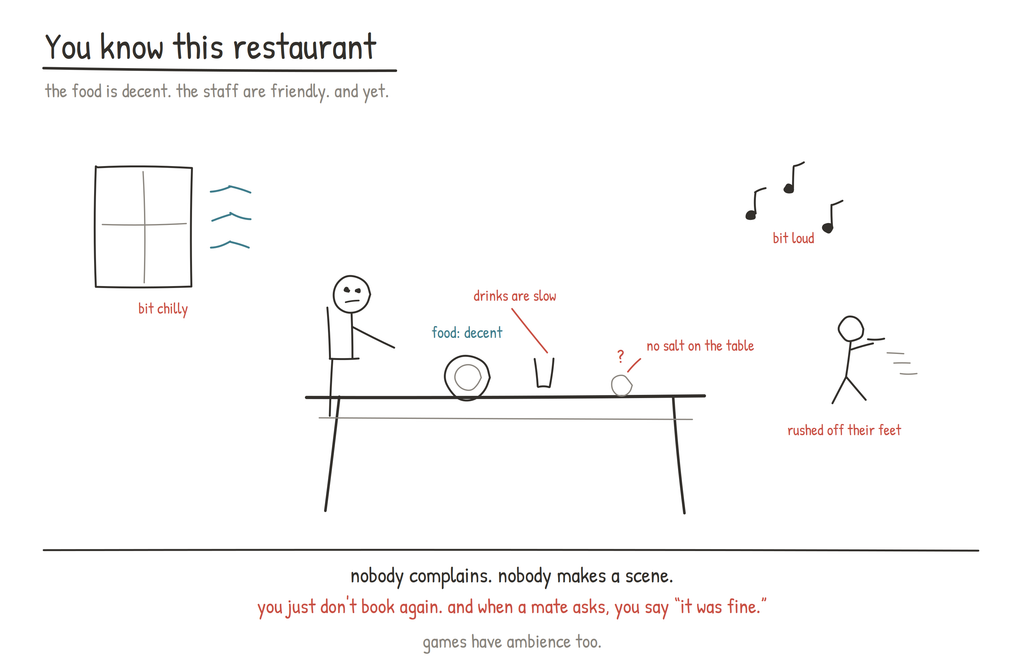
Imagine you go for dinner at a restaurant. The food ends up being decent, maybe even good. The staff were friendly.
But you faced some small things that added up throughout the night. Small things like:
- You were seated at a chilly area
- The music was slightly too loud
- Salt & pepper missing from the table
- Staff visibly overworked
At the end of the night, your friend asks how it was.
You're likely not going to say it was bad. You also aren't going to storm out over missing salt.
But you might say it was "ok". Or "It was fine but..." etc. You get the point.
Those small complaints, that "but" at the end of your review is the ambient frustration.
And it could be the deciding factor that makes your friend go somewhere else for dinner.
It could also be what stops you from returning.
On their own, none of these issues are a problem.
Group them together; it can set a tone for your evening.
Experience them all in a short burst, with no food in sight yet? Even worse.
Paper cuts
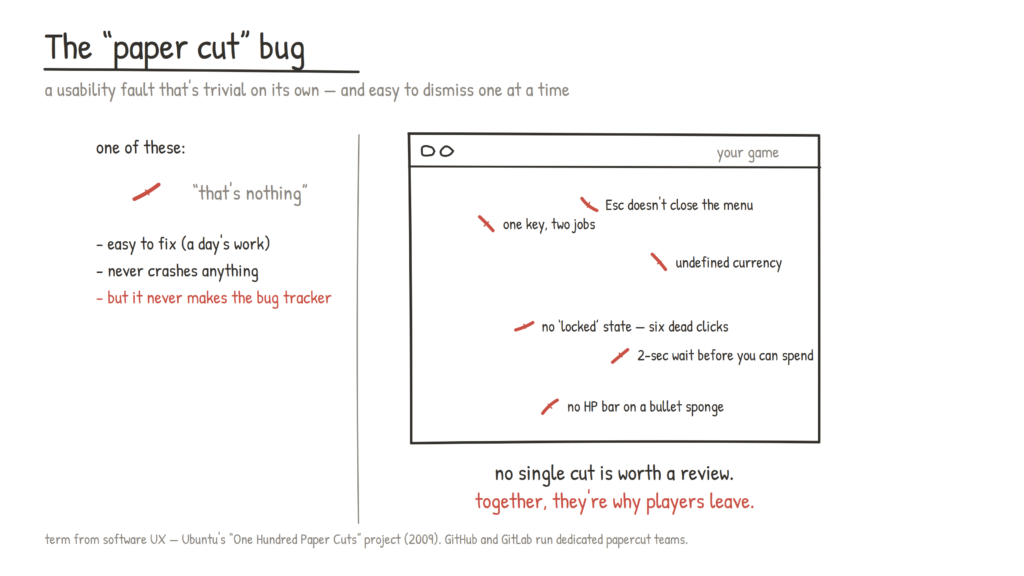
The "paper cut bug" is a term more often used in traditional software development and user experience (UX) design. A paper cut bug is a trivial usability bug on its own, which is easily fixable.
While it won't cause core breakdowns in functionality or crash the system (or game, in our situation) it will cause visible and unnessecary friction for everyday users. Exactly like a paper cut. Small on it's own, not seriously damaging. But definitely painful and annoying.
Check this, GitLab (devops platform) actually runs a team dedicated to paper cuts on their systems.
How does this translate to games?
Paper cuts describe the bugs from the dev's chair. Ambient frustration describes the weather from the players chair.
When the small annoyances the player is facing mount up, they take on a sort of multiplier. The pile of small issues becomes an overall vibe.
My own experience with Dome Keeper
Dome Keeper is a fine game. Infact, it's better than fine. It's 93% positive on Steam as of writing this. That's got to mean something, right?
But from my own experience, a number of small but frustrating issues led to 2 poorly experienced play sessions. These collectively made up 104 mins of gameplay.
The common response to this is often "give it time", "you didn't get to {X}", or even "git gud".
But with Steam's 2 hour refund timer leaving me with 16 more mins, my decision was made. I no longer wanted to play.
And not for any single glaring reason. Instead, it was because of numerous small paper cuts that led to a sense of ambient frustration (as I decided to call it).
Now, I'm aware my single loss of business won't affect Bippinbits too much. Dome Keeper sold around 1.5 million copies & the game has seen serious recognition for it's gameplay.
It's a great game.
Unfortunately, due to my own preferences, mixed with small irritations, I was unable to muster the will to revisit the game after 104 minutes.
Dome Keeper places time as part of the game's antagonist. Everything takes time - traveling, mining, carrying goods, processing goods. All while a timer runs down until your next base attack. Fail to defend it = run over.
This bit is on me: I don't enjoy games where real time is part of the tension (one exception being Crazy Taxi and games of that ilk; that's a different rabbit hole).
Combine my lack of engagement with real-time stress mechanics with small annoyances:
- Strange default keybinding
- One interact key, which Drillbert kept getting in the way of when I'm trying to pick up things
- Lack of direction from the outset. I'm not looking for hand-holding - but some sort of rough guidance through the run (at least initially).
All of a sudden, I found myself getting bothered by more and more. The ambient frustration set in. I started to get frustrated by the upgrade system. Too many options thrown my way. Each feeling uninspiring. I realized this was being compounded, possibly unfairly, by the small frictions that I had already experienced.
But this is a note about Ambient Frustration. Not Dome Keeper, which I did a Five Feels write-up about here.
How it builds
The formula: fault frequency * arrival rate vs how fast the game pays goodwill back.
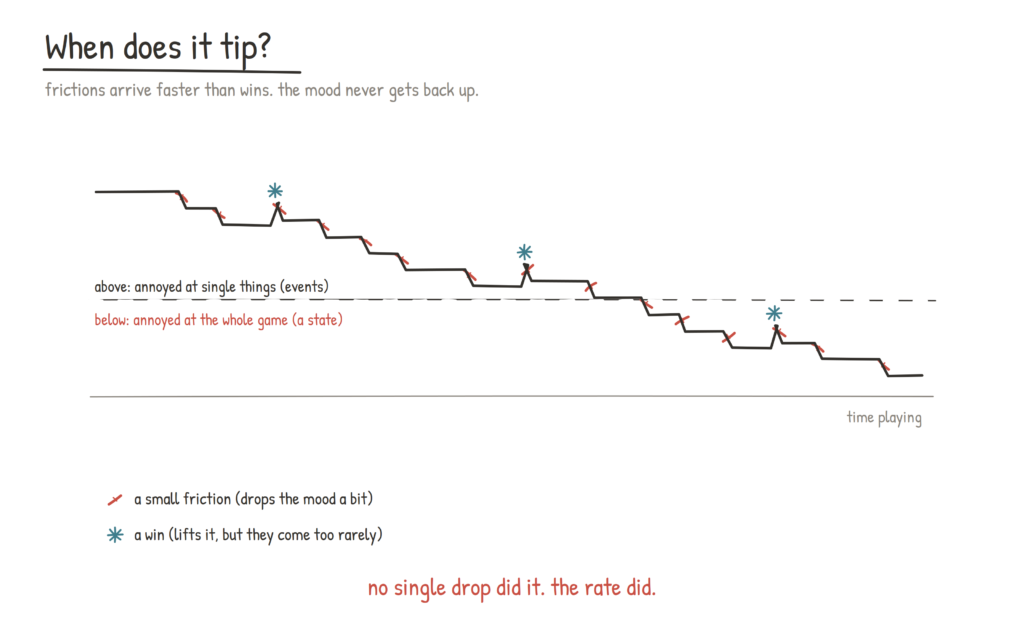
When the friction arrives faster than wins, irritation sets in. Wins become worth less. An overall sense of tension during gameplay in a non-flow state diminishes the overall experience.
Think of a bucket with a hole in it.
Annoyances pour in at the top.
Good moments drain them out at the bottom.
If stuff pours in faster than it drains away, the bucket fills up.
It doesn't matter that each drop was tiny.
The difference between this and a big problem, like a freeze or broken feature, is that big problems get noticed and patched.
Small issues can take much lower priority, thus taking longer to fix.
Or, they can be the result of fundamental issues of game mechanics.
Which is a much more complicated fix.
Why you'll never see it in your feedback
You'll get dedicated users pointing out each small issue that pissed them off. When you do, be grateful.
Those users are invested enough to take the time to point them out to you.
Even if they're just venting and expressing their frustration at your game.
It helps you improve the situation going forward.
But don't rely on users like that.
The plumber analogy
You have a leaky sink. Washing the dishes this morning turned your kitchen cabinets into a river. Great.
You call the plumber to come take a look.
When he arrives, he goes into great depth about all the ways he can fix it.
Using all the plumber and water-related jargon that only a plumber would know.
You stand, bewildered at how there are so many different terms for a tube that directs water.
The reality is, you just want to wash the dishes with no leaks.
You don't care what the problem is or what the fix requires.
You want the sink to function properly like one.
Players who buy your game want to have fun.
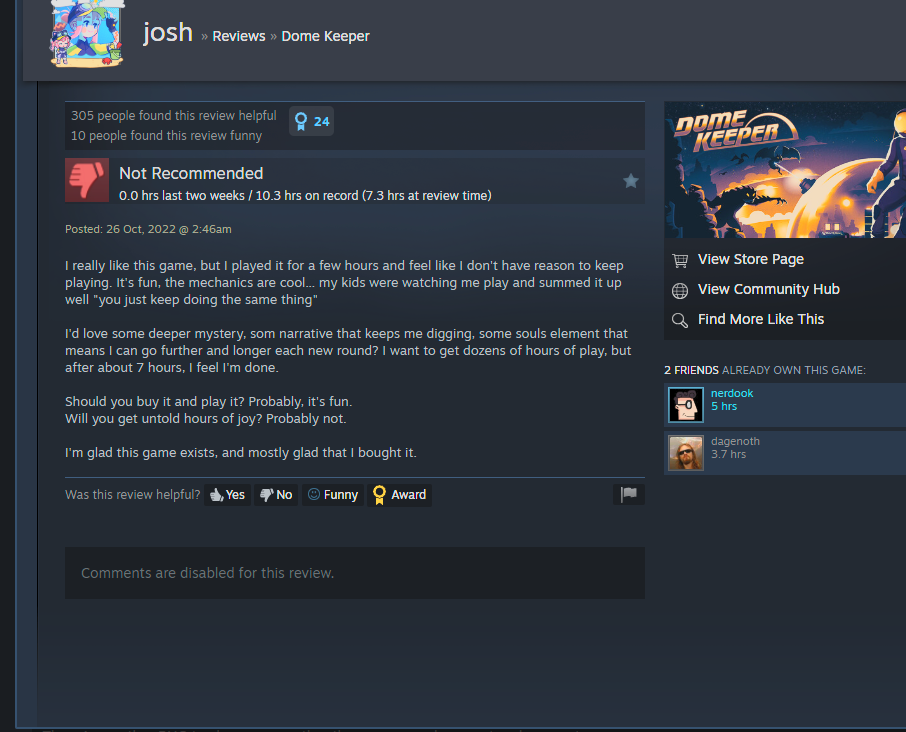
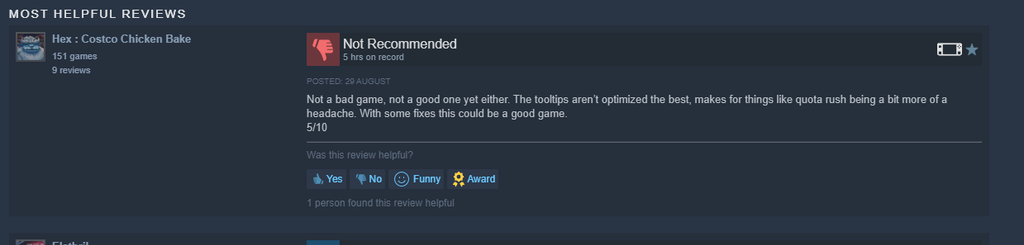
When they don't experience fun due to ambient frustration, the reviews often look like "It's not bad but I didn't enjoy it" or "Meh".
Take a look at some Steam reviews which convey elements of ambient frustration:
It taxes your good moments too
Thinking back to the restaurant example - the waiter was lovely. But you've forgotten that from being sat in the cold for 40 minutes waiting on your main course.
Dome Keeper seems to be the example I'm using for this post. It's what made me clock onto the idea of ambient frustration.
After winning a run you pick a reward from a choice of 3.
That's generally good and widely used design, especially since roguelike deck-builders have become so popular.
Yet, I felt hardly anything.
I actually noted at the time:
"If the game didn't frustrate me in so many other ways, it wouldn't matter. Things feel like they are kinda compounding"
I started to feel tense about the idea of my chosen upgrade being poor.
Then having to endure another run with a lackluster reward from my victory.
In the end - the reward was given to the same player that had been enduring numerous frustrations for the last 40 minutes.
What to actually do about it
We know the problem now, but how do we address it?
Playtest
- Players love being behind the scenes in game dev.
- If you can get people with a genuine interest in your game, they'll give you detailed criticisms.
- If you get vague 'Yeah it's fun' or 'It was fine' - something is up.
Test it yourself
- Play it as if you're the customer. Disconnected from your dev brain. This is part of a larger piece I'm gonna write up.
- This may not come easy at first. You might need to disconnect by not looking at your project for a week or so. Get as far away from the developer/creator mindset as possible.
- Be truthful when you play it. Ask yourself if you'd pay for the game if it wasn't yours.
- How does it genuinely weigh up against competitor games?
- Kill the ego.
Steam Community
- If you have an ongoing playtest or demo, stay on top of your community tab.
- Answer & address problems that people report there (I don't mean literally, although that's a good practice too. But take note of what is said. If players are taking the time to go to community and write threads, it's worth taking seriously).
The Caveat
Watch out
Ambient frustration can appear in any game. It doesn't necessarily make the game 'bad', but it can be a slippery slope.
This is NOT "the player didn't like your design". Dark Souls being hard, slow travel in some games - that's friction on purpose.
I can stop and appreciate that the ticking clock is part of the tension behind Dome Keeper. The fact that I didn't enjoy it is a clash of my preferences and the game's intended design.
Players sign up for these challenges, or they don't.
Ambient frustration is friction nobody signed up for, and nobody benefits from.
No player's day is improved by a mysterious UI icon with no tooltip to explain it.
[…] I won’t lie, when I encountered this, I already had several other frustrations with the game. Leading to ambient frustration. […]