Why am I writing this?
It has been 23 days since I launched Working Class Monsters on Steam.
The launch didn’t ‘bomb’ – since I knew from the offset that it wasn’t going to be the next hit indie game.
I launched it with just over 800 wishlists.
So I was under no illusion that I had to perform much better on my third release.
But what does this mean?
How does one get more wishlists? Sell more copies? Get more Youtuber coverage?
There’s hundreds of ways to answer each of those.
Just take a scroll down a game dev Youtube feed and you’ll see the plethora of channels spouting their opinions.
I wanted to take it back to it’s core. Stop overcomplicating game dev.
Maybe stop calling it ‘game dev’ and call it ‘making a game’.
Maybe stop calling them ‘games’ and call them ‘toys’ instead?
My point is, everything back to it’s absolute roots.
Why do we play games?
To have fun.
So, I’m writing this after spending the last 3 weeks playing many different games.
With the goal of figuring out:
- What is fun?
- When do I feel it?
- How can I create it in my next game?
This blog will explain some of what I’ve discovered so far.
Mainly, the concept of ‘The Allotment’.
The Allotment
An allotment is a small plot of land you can grow fruit, vegetables & flowers on.
It’s not in your garden or attached to your home.
Usually you rent it from a community.
But it’s yours.
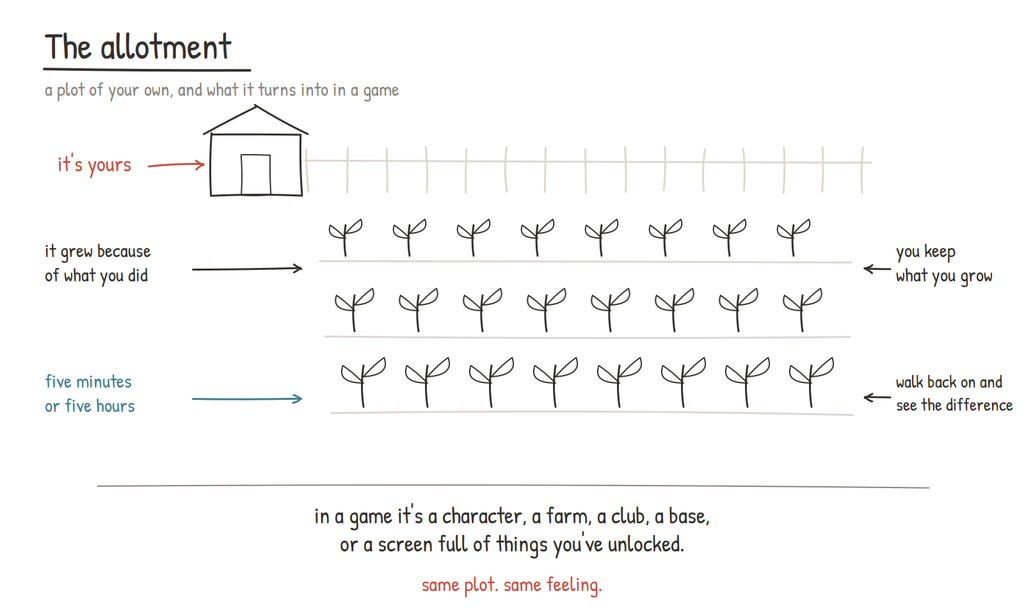
You grow on it whatever you please.
And you get to keep whatever you grow.
You can go to your allotment whenever you want.
You can spend 5 minutes watering your plants.
Or you can spend 5 hours digging it up and re-arranging it.
What this means in a game
I think this concept became popular when base-building games really became a thing.
But I truly think it has a wider context and can be applied to most games where you have 1 or both of the following:
- You have a permanent place to retreat to
- You have some sort of permanent entity you upgrade and watch grow
It means that whatever effort you put in to a gameplay session, whether big or small, has an output.
Pushing your allotment forward, making progress.
It may be visible progress or a tiny bump in numbers.
What matters is – any effort you put in advances you.
No time is wasted.
And the game can fluidly fit around your real life schedule.
Examples of gaming allotments
Allotments can come in many forms.
Some of them you need to look closer to see.
Let’s start with the most obvious one first – a colony.
A settlement
Your job is to build it and survive.
It’s yours & you decide the direction to take it in.
- Rimworld: Making a home, sustainable, a machine that lasts. Losing a settlement feels tough and carries weight. Sometimes it can be tough to mentally start again. You can play for 5 minutes to gather food, advance research or just check in. Or, (more likely) you can play for hours at a time, building work shifts and assembly lines to keep your colony safe.
- Ball x Pit: Your settlement above the pit is the meta progress of the game. It’s responsible for unlocking new characters and improving your in run stats. It stays static and each run you do helps to push your settlement forward. This synergises back around, improving your runs.
A character
Your representative in the world.
In a RPG, literally the role you take in the world.
- World of Warcraft: You level up, get stronger and go to zones that were once too dangerous. You gather resources and sell them in a real economy, getting gold to buy better equipment. You get better equipment to access more zones, dungeons and raids to explore more of the game. A game session can be 5 minutes of gathering herbs or 5 hours of dungeon delving.
- Fable: You level up your various skills to become more powerful. Then you can buy or “come to acquire” various pieces of real estate that are now yours to decorate and customize. Your character also takes different shapes, depending on the moral choices you make during your journey. Taking on demon horns if you perform enough despicable acts.
- Dark Souls Series: Each character you make is a fresh canvas to paint your build onto. You choose your stat distribution, between various like Strength, Dexterity and the like. These choices then effect what weapons you can wield and how well you can use them. A session can be 10 minutes of acquiring souls (the leveling currency) and scouting out the map further (improving your knowledge) to find the next save point. Or hours spent trying to defeat the next boss.
A collection
This one’s a bit less obvious.
An unlockable screen or a collection panel, with the right rewards, can also be an allotment.
I’m not an achievement freak.
Infact, I hardly even take notice when I get Steam achievement popups.
But a lot of players are, so this one may have even more weight than I can currently comprehend.
- Path of Achra: One of my favourites over the last 10 years, honestly. The game starts with a character creator – choose a race, class & religion (already got me hooked). First game, you’ll see about 80% of the options locked. But as your runs progress further toward the final boss, you’ll see these locked options start to become available. This on it’s own isn’t enough (as we’ll explore). But the unlocks provide so much weight in the game, that the character creator screen becomes an allotment. Each time I want to try again with fresh game knowledge and strategies – I return. Back to my paint palette where I begin theory crafting my next build.
- TimeSplitters Series: This allotment hooked me as a kid, so there’s a bit of nostalgia factor here. Although, I believe it’s still valid. There’s a collection screen you can find which shows icons of every character in the game. Locked ones show only a silouette. This makes me feel like a kid at the toy shop – asking for a new lego set, to be told we can’t afford it. It makes me want it more. Although, with TimeSplitters, I also want to just see what whacky character sits behind that silhouette. Combine that with the fact that the game offers so many bizarre and fun methods for unlocking each character that the unlock criteria are never the same. If one mode gets repetitive, you can just swap out to something else to freshen it up. As long as you have enough left to unlock, you’ll be making progress. Missions take longer, but some side challenges can take 10 minutes – flexibility in the time you have available again.
A business
Similar to the colony and you can pretty much use the same examples really.
Bu the idea is you have a machine that you work to get self-sustaining.
Whatever progress you make in the main chores of the game progresses your machine (the business).
- Stardew Valley: Your farm & town. Grow crops and raise animals. Start by doing it manually, then invest your coin to automate it with machines. Freeing you to take up other responsibilities while still making bank. Invest the coins in farm upgrades, improving the machine again. Or invest in the town and community centre to unlock more regions & story beats. Dangerously delve into the mines when you are ready to get more equipment upgrades and valuable resources. Each in game day takes roughly 14 minutes. If you have the self-discipline, you can boot it up and play 1 or 2. Usually a full season passes before you realize it’s getting dark and you’ve neglected the rest of your life.
- Football Manager Games: Or any other sports management games, but FM is my thing. The club is usually my allotment. I’ll take control of some lower league, semi-pro team. The guys at the club are playing on saturday afternoons, then hypethetically going to work their day job right after the match. My goal? Take them to the top and win all the major trophies. This is a long project. But FM is brilliant at respecting your time. A match can be played in 15 minutes if you take it serious, or 4 minutes if you quickly skip through. You can even auto-resolve. If you don’t feel like going through a match but have 20 minutes to spare, I found joy in scouting the furthest corners of the world for the next addition to push my team further. There’s real joy in finding a 19 year old striker from New Caledonia, developing him and watching him sign for a big club.
Now here’s an interesting part – This is a game style a lot of players opt for. It has clear visual progress. You can post a screenshot of your once tiny local club winning the Champion’s League and everyone with sensible football knowledge will understand. Another allotment is your manager. You create a manager at the start. You can be approached by other clubs when your feats become noticable. You negotiate contracts and wages for your manager. You can work your way from a local team manager, to leading the biggest clubs in the world. The problem with this (and why it’s a style I’ve never went for) is there’s no visual to this. Your manager still wears the same suit you picked at the start. You don’t get a fancy yacht or even office when you transfer to a bigger club. There’s nothing to represent your progress aside from being the manager of a big club. But you can just choose them from the start of the game anyway. - Schedule I: One of the best I’ve played in a while. Everything you do pushes you forward. Buy more equipment, even a plantpot pushes your operation forward. Buy bigger properties to increase your space. Purchase businesses to improve your money laundering operation. Go a walk and offer strangers free samples of your product, leading to a bigger customer list. Each day is 20 minutes or so, so slightly longer than Stardew, but the concept is the same. Jump in, spend hours building up your business and notoriety… or spend half a day (10 minutes) packaging, growing, cooking or delivering product to customers. It all pushes your operations forward.
- Some other worthy mentions (the DNA is the same, so I won’t go too in depth): King of Retail, Supermarket Simulator, Game Dev Tycoon, Software Inc.
Foraging to take home
A good way to think of designing an allotment, is the act of foraging to take goods home.
It’s one of the oldest primal feelings that exists in all of us.
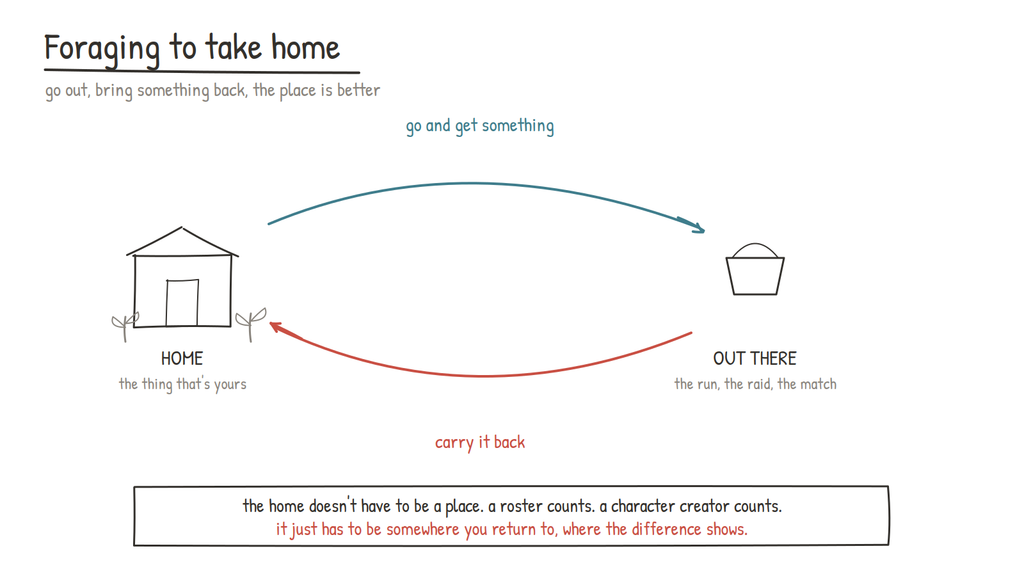
So games that give you an allotment – often let you scour the world for seeds and tools that you can take back to improve the health and wealth generation of your allotment.
- World of Warcraft: Gathering materials, earning gold, collecting XP and gear -> Your character
- Football Manager: Scouting good players, winning matches -> Your club
- Schedule I: Finding new customers, equipment, mixers -> Your base and production lines
- Gladiator Command: Winning battles, hiring staff, buying weapons, recruiting fighters -> Your gladiator school
- Path of Achra: Finding weapons, creating a broken build & winning a run -> Your character creator has new options and ways to play
- Software Inc: Taking contract work, hiring staff, growing the offce -> The software business of my dreams
Any playtime grows my allotment
I think this is part of the reason why I felt out of love with World of Warcraft.
Now there’s many reasons for that.
Far too many to list.
One thing stayed consistent, the allotment in WoW is your character.
And in Classic and earlier expansions, like TBC and Wrath, I could log in and play all day.
Or I could quest for 20 minutes and be done.
Both would move me forward.
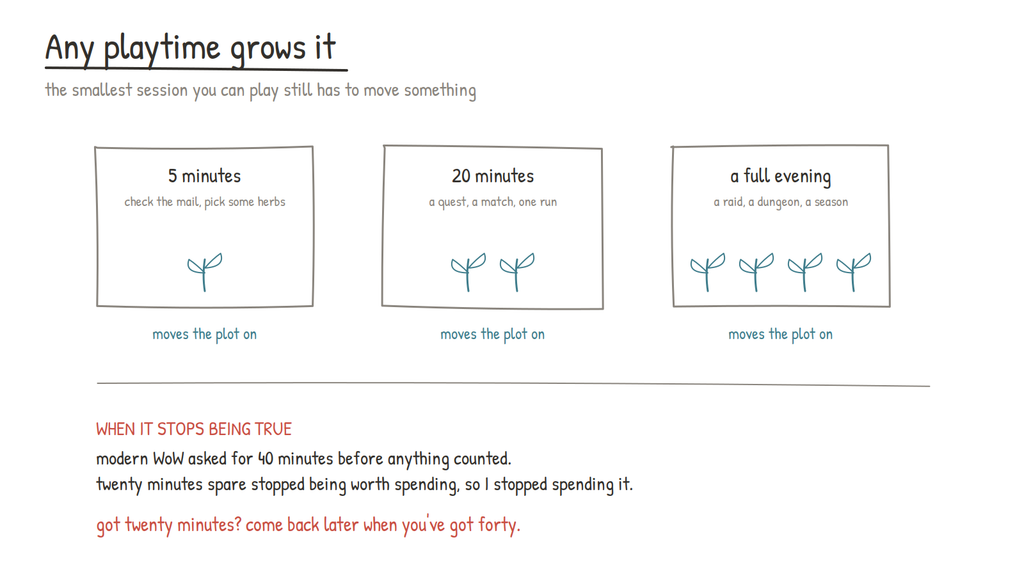
Playing all day would let me do more time consuming group content for better gear,
Questing could get me more money and XP, moving me closer to the max level.
Hell, one of my favourite activities was just logging in, picking herbs, making potions and selling them on the auction house.
Some of my most peaceful sessions involved being level 20 & doing that with a podcast or football on my second monitor.
But in later years, an emphasis on max level content meant that the pre-max level game felt meaningless.
The developers introduce a max level boost (pay real $$ to get max level).
The world also started scaling with your level.
Meaning you could go anywhere and the challenge would scale and be the same.
It also became trivially easy, meaning gear before max level felt meaningless.
Let’s say the max level in modern WoW is 60 (I’m out the loop, so that number may not be accurate).
Because of the changes I just described, anything before level 60 no longer feels like you working on your allotment.
You don’t actually get the keys to your allotment until you get max level.
Then, when you do, gold became so inflated and worthless that gathering and selling became less important.
A bit like getting an allotment and being told you won’t be able to grow flowers or fruit there.
So you’re left with turnips.
Then, in the case of WoW, all the gear you’d be chasing would be hidden in dungeon or raid content.
Where you’d require sometimes at least 30-40 mins for dungeons.
And at minimum 2x that for a raid.
The idea of put in whatever time suits you became less optimal.
Purely because your efforts would yield less or nothing at all.
Got 20 minutes to spare? Best come back later when you can add 20 more to that.
Halls of Torment vs Thronefall
So when I was researching this topic & exploring my thoughts, I ran into a bit of trouble.
I couldn’t work these two out.
One hooked me for weeks, the other felt lukewarm.
On paper, the allotment seems the same.
So I decided to dive a bit deeper…
And look into how the growth of the allotment in each game impacts the overall experience.
Remember when I spoke about Path of Achra earlier – I mentioned that a screen full of hidden unlockables isn’t always enough…
Let me explain why:
Both games are run based. They both require about 20-30 minutes to complete a run.
Thronefall gives you the option to quit & save mid run. Halls of Torment (HoT) doesn’t. Quit mid game? Prepare to start over.
Both have a bunch of unlockables.
Unlockables
Halls of Torment
- Heroes new characters to play as
- Gear to start a new run with
- New Abilities to discover on a run
- New Traits to make your existing characters more powerful
Thronefall
- Weapons for your ruler to use during battles
- Perks to change your strategy during a run
- Mutators to increase difficulty and rewards
Thronefall actually does a better job of illustrating your progress.
Starting a new run shows your collection, with dark silouettes hiding what you’ve yet to unlock.
You’re also shown visible progress towards your next unlock after each run.
Regardless of how poorly you performed.
And yet, it couldn’t hook me.
Definitely not the same way that HoT did.
When I stopped to think about this, it confused me.
Thronefall did so many things better.
The gameplay is solid too.
But I didn’t feel compelled to unlock the new toys to play with.
Yet in HoT, I couldn’t wait to get my hands on the Norseman and Beast Huntress in particular.
It recaptured that childlike excitement at getting my hands on a new toy.
It took me a while to examine my thoughts and notes, but when I did, I put it down to this:
Thronefall -> runs felt repetitive, I could foresee each game before I started. HoT -> I knew the gist of my run, due to my chosen hero, but the rest of the game was a mystery, waiting to revealed by in-run upgrade moments.
Let’s explore.
When I load in, that’s it
Thronefall has a pretty standard in-run experience.
You have empty plots with pre-determined buildings that you can place on them.
The buildings either defend, generate income or produce units.
Your selection of pre-run weapon, perks and mutators will impact the run experience you have.
But nothing inside of the run will dramatically force you to think differently.
No choices will be thrown your way.
Compare that to HoT:
The prerun choices still exist – pick a hero, pick gear to equip.
Then pick a level.
All extremely similar at this point.
But when we load in – we level up & choose what abilities or upgrades to select.
We have treasure in the world with vague directions on how to reach them.
Once we do, we’re given a random upgrade which has the potential to totally shift our build trajectory.
This keeps the experience fresh.
I could play 3 runs with the same gear & hero.
Yet each build varies due to my in-run choices.
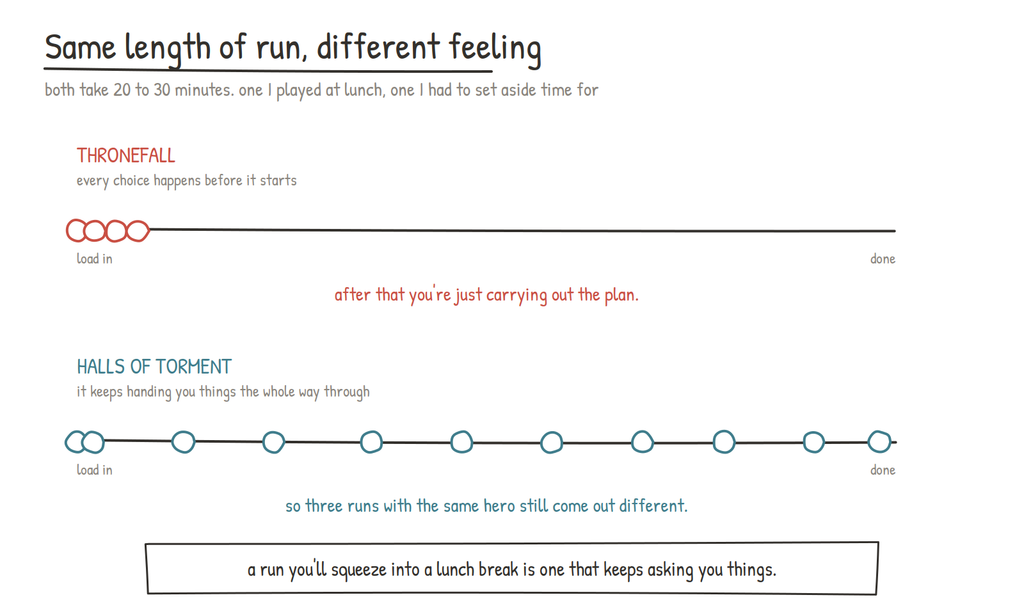
But when I try this in Thronefall, nothing shifts.
That’s why Thronefall is a fine second monitor game.
But not something like HoT, where I can find magic in playing it with no distractions.
A fix I keep landing on
There was a time before I landed on the theory of the allotment.
I was playing games and realizing a bunch just couldn’t capture me.
Despite being highly rated games like Dome Keeper, Kingdom and Curious Expedition…
They just failed to keep me hooked.
Through all my notes and feel logging – I noticed something…
They didn’t provide me with a foundation I could build upon with each session.
An allotment!
Before I discovered this… I kept noting down ideas on how i’d change these games.
What they could do to keep me hooked.
See if you notice a pattern:
- Curious Expedition: Imagine a lodge for your explorers’ league. You return to it after each expedition. You can keep relics here as trophies. Unlocking new explorers means attracting them to show up in your lodge. You can place all the trophies you’ve won in your lodge and watch it grow.
- Kingdom: I love the Kingdom games and the fantasy. But you finish the settlement and move on. Never to see it again. Make it a permanent run. Make the Kingdom part the meta game, with some sort of outpost creation or island hopping to upgrade your main home.
- Conquest of Elysium: Truly a wonderful roguelike and it’s a game I enjoy immensely. But one part always felt flat – the management of your lands. It’s not the focal point of the game, so it’s understandable. But some more weight in the building and operating of settlements would bring me so much more engagement to this game.
Games that did & didn’t hook me
I’m not going to over analyze this part.
Some of it can be put down to the allotment theory.
For other games, there may be another reason.
This is purely a dump:
Hooked
Ball x Pit -> watching my settlement grow and my unlocks & power ramp up.
FTL -> Easy to restart and provides plenty of BUMs (build upgrade moments). Ship unlocks feel fun, but the random nature and lack of guidance can lead to frustration.
WoW -> Building up a character as your avatar in the world through various activities is still one of the most powerful allotments.
Rimworld -> The purest form. Your allotment is everything in this game. Lose your allotment? You’ll need to find a new one.
Stardew Valley -> The game is literally about gardening. Then going out, finding things to bring back to your farm and using them to push you forward. The size and health of your farm in this game represents your progress.
He is Coming -> The allotment here is a bit looser. The only unlockables are skins, which have no gameplay impact, other than serving as a medal that shows you beat the bosses on the highest difficulty. Yet, I chased them, for hours and hours. Why? Still trying to work that out. I’m not a skin collector. But what I do know is the build variety is very wide, the runs are really short and you can pick up and start again instantly. There’s literally 0 friction to trying again when you die. It’s like pulling the lever in a slot machine and each time you do so with more knowledge. Maybe your knowledge of the game is the allotment here?
Not hooked (or only partially)
Endless Dungeon -> Don’t know where to start with this one. Meta goals? Get more characters? Don’t really know who they are. It’s like going to a toy store and only seeing what you can buy… maybe because the owner decided to hide everything you can’t afford! There’s nothing driving me forward. I don’t play this game and make objectives in my head.
Dome Keeper -> The unlocks are infront of me… But I don’t feel like they’re going to really impact my game much. Combine with the constant friction I felt when playing (covered here) and my appetite to play and grow my collection never really existed.
Thronefall -> A great game, one I’d likely revisit when I want to 50/50 it with a football game or podcast on the side. But the in run gameplay doesn’t provide me with enough choices. The unlocks don’t scream for me to chase them.
Losing the game
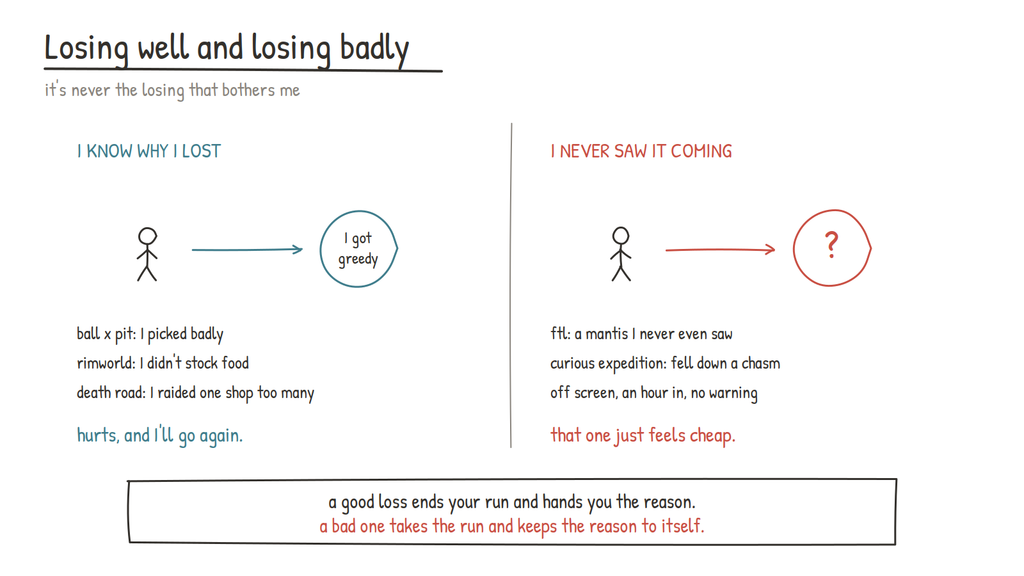
One of the most important parts, I’ve learned, is how you treat the player when they inevitably lose a run.
The best games don’t treat your failure as failure, but they almost treat it as the end of your bubble of progress..for now.
But don’t worry! You can just get a new bubble and start again.
That’s how the best games keep you (me?) hooked.
They don’t need to be run based.
This is the final point of this post.
And it’s a vital one.
So let’s look at some examples.
Good ones first:
Ball x Pit -> Poor run, I die, I know exactly why. I was given the tools (perks, abilities, upgrades) and either didn’t choose well or didn’t play well.
Rimworld -> Colony starved? Stock more food next time. Raider’s destroy the base? Focus on weapons. Disease spread through my colonists? Better focus on doctor skills next time. The game will always look to throw you a curveball. That’s part of the joy. But you never truly feel cheated.
Death Road To Canada -> Losing party members because I decided to get greedy when raiding a supermarket. Ok, watching my dog getting mauled by zombies felt dreadful. Yet fair. It added to the drama of the story of my run. Even if it hurt like hell.
Football Manager -> Losing my best player to another team. I’m still a small club. I managed to find my New Caledonian 19 year old wonder kid and he scored 30 goals in a season for me. So, understandably he decided to sign for a bigger team.
Schedule I -> Not run based, but get arrested? Lose cash and product on you at the time. But your operations and bases are not harmed. It’s wonderfully handled. My only dislike is when dying in singleplayer, you are returned to your last save -> Die at 4am and you haven’t saved all day? You gotta do it all again. Feels a bit archaic in 2026. Especially when the multiplayer mode loads you outside the hospital with a bill (so i’ve heard).
Then some that weren’t so good:
FTL -> I had an incident where a case was flying past my ship. I had the chance to ignore it or stop and open it. With these decision, FTL gives you zero knowledge on what the repercussions will be. Fully tapping into the fantasy of being a spaceship captain. But surely given that fantasy, you’d roughly have an idea of what could be hiding? We as the players, do not. So, imagine my rage when I open the case & a mantis decapitates one of my vital crew members. No way to have guessed it, no way to choose who opened it & no way to avoid it. Just a A or B choice and a permanent death as a result.
Pre-2004 MMORPGs -> There’s a reason WoW blew up. They removed the XP loss on death that old school MMOs used. I’m a WoW baby, so I can only speculate. But I can’t imagine spending some hours making progress, just to die and lose a chunk of it! This is also a dead MMO feature that doesn’t exist outside niche audiences.
Curious Expedition -> Probably the most egregious one I encountered. Runs in Curious Expedition are made up of 6 expeditions where you must find the golden temple in each. Each expedition takes roughly 10-15 minutes. So a full run is around 1 hour. My first playthrough got me to expedition 5 before I had to leave for the day. I already wasn’t totally compelled to return, but, it’s awful unfair to judge a game without finishing a single run!
Anyways… I returned to finish my final 2 expeditions. Hoping that the pay off in unlocks or feats would be worth it. After all, I had been leading against my opponents pretty comfortably the full game. When all of a sudden, 10 minutes or so into my final expedition, I’m hit with the popup ‘You fell down a dark chasm’
Game over.
My jaw almost hit the fucking floor man.
I didn’t see it coming, nor did I see it happen!
I was off scouting areas of interest while my party made progress to the next village.
This is less about the RNG event & more about how it’s handled.
Almost like hearing ‘It’s not what you said, it’s how you said it’.
Sound familiar?
This was the gaming version of that.